

Roadmaps Best Practices
Deprecated. Structuring and scoping a roadmap.
This workflow uses Plans and Blueprints. Start with those if any is unfamiliar.
Planning Your Roadmap Structure
Before adding recommendations, define the scope and purpose of each roadmap. A well-structured roadmap aligns architectural improvements with a specific initiative, planning cycle, or business objective.
Recommended Roadmap Structures
- Initiative-based: Group recommendations around a specific project such as a cloud migration, post-acquisition integration, or platform modernization
- Priority-based: Organize recommendations by their priority classification (adopt now, adopt later, hold) to sequence execution by urgency
- Domain-based: Use architecture domains (Infrastructure, Data Architecture, IAM, Monitoring) to create focused roadmaps for specific technical areas
- Time-based: Align roadmaps with quarterly planning cycles, sprint cadences, or fiscal year objectives
Structuring Best Practices
- Limit each roadmap to a single initiative or objective. Broad roadmaps with unrelated recommendations become difficult to track and communicate.
- Name roadmaps descriptively so stakeholders understand the scope without opening them (e.g., "Q2 Infrastructure Cost Optimization" rather than "Roadmap 1")
- Plan your roadmap structure before adding recommendations. A single recommendation can only belong to one roadmap, so reorganization requires removing and re-adding items.
Adding Recommendations to a Roadmap
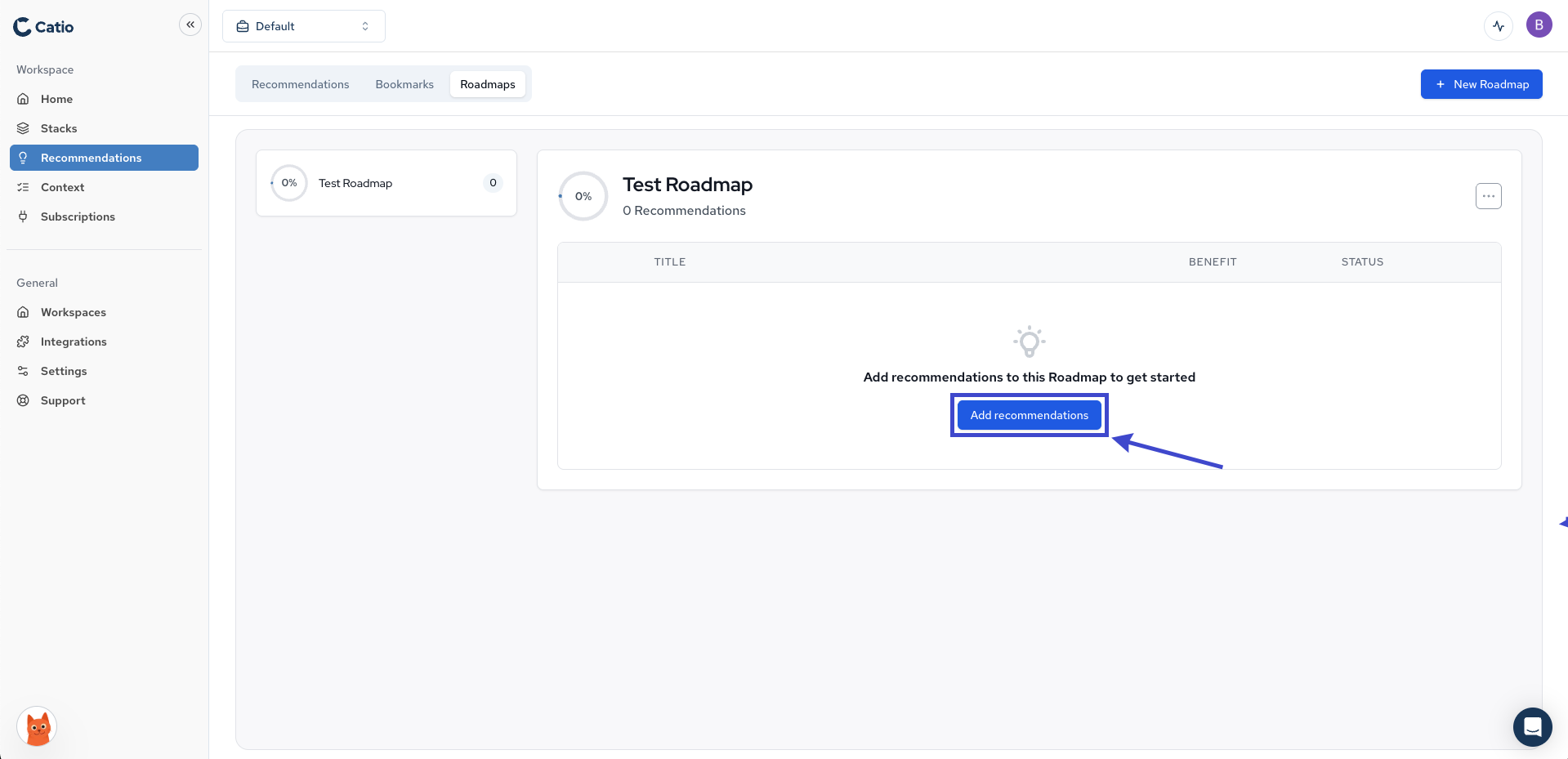
Use the Add Recommendations modal to search, filter, and select recommendations for your roadmap. Each filter narrows the available recommendations to help you build focused, relevant roadmaps.
Effective Filtering Approaches
- Search: Locate specific recommendations by keyword when you know the component or system being addressed
- Domain: Filter by architecture domain to build domain-specific roadmaps (e.g., filtering by "Data Architecture" for a data platform modernization initiative)
- Benefit: Filter by expected benefit category to align recommendations with a specific business outcome
- Batch: Filter by recommendation generation date to ensure your roadmap reflects the most recent analysis
Adding Recommendations Best Practices
Start with high-priority "adopt now" recommendations for initial roadmaps. These represent high-impact, lower-risk changes that deliver quick wins and build organizational momentum for larger initiatives.
Effective roadmap composition includes related recommendations:
- "Migrate primary database from self-managed PostgreSQL to managed Aurora PostgreSQL"
- "Implement read replicas for reporting queries to reduce primary database load"
- "Configure automated backups with cross-region replication for disaster recovery"
Avoid grouping unrelated recommendations in a single roadmap:
- "Upgrade API gateway" alongside "Implement new IAM policies" alongside "Migrate to cloud-native monitoring"
- These address separate systems and should belong to separate, focused roadmaps
Tracking and Maintaining Roadmaps
Each roadmap displays a completion percentage and individual recommendation statuses. Regular review ensures roadmaps remain aligned with current priorities and resource availability.
Tracking Best Practices
- Review roadmap progress at a regular cadence aligned with your planning cycle (weekly, bi-weekly, or per sprint)
- Update recommendation statuses as implementation progresses to maintain an accurate completion percentage
- Revisit roadmaps when new recommendation batches are generated, as updated analysis may surface higher-priority items
Using Roadmaps for Stakeholder Communication
Roadmaps provide a structured view of planned architectural changes that can be shared with leadership, engineering teams, and cross-functional stakeholders. The completion percentage and status tracking offer visibility into progress without requiring technical deep-dives.
Effective stakeholder communication with roadmaps:
- "Q2 Infrastructure Optimization roadmap is 60% complete with 3 of 5 recommendations implemented"
- "Post-acquisition integration roadmap has 12 recommendations across Data Architecture and IAM domains"
Avoid presenting roadmaps without context:
- Sharing a roadmap without explaining the initiative scope or expected business impact
- Presenting completion percentages without noting any blocked or deprioritized recommendations
Why Roadmaps Matter
Catio generates recommendations by analyzing your architecture against your business and technical requirements. Roadmaps provide the execution layer that transforms this analysis into measurable progress.
Without roadmaps, recommendations remain individual items without sequencing, ownership clarity, or progress tracking. Roadmaps enable your team to prioritize competing improvements, communicate architectural strategy to stakeholders, and track modernization progress over time. The more intentionally you structure and maintain your roadmaps, the more effectively your organization can execute on Catio's guidance.
Updated 4 days ago