

Interpreting and Acting on Blueprints
Read a blueprint critically and decide whether to act on it.
This workflow uses Blueprints and Plans. Start with those if any is unfamiliar.
This guide is about reading a blueprint critically: how to interpret its three analytical sections and decide whether it is worth acting on. For a tour of every section on a blueprint, see How to Best Utilize Blueprints.
Every blueprint is built on the same three analytical sections: Target State, Gap Analysis, and Implementation Plan. Together they answer what should change, why it needs to change, and how to get there.
Throughout this guide we follow one example: a platform team migrating a monolithic order-management application to event-driven microservices.
Clicking the blueprint title or View Full Blueprint opens the full view.

Target State
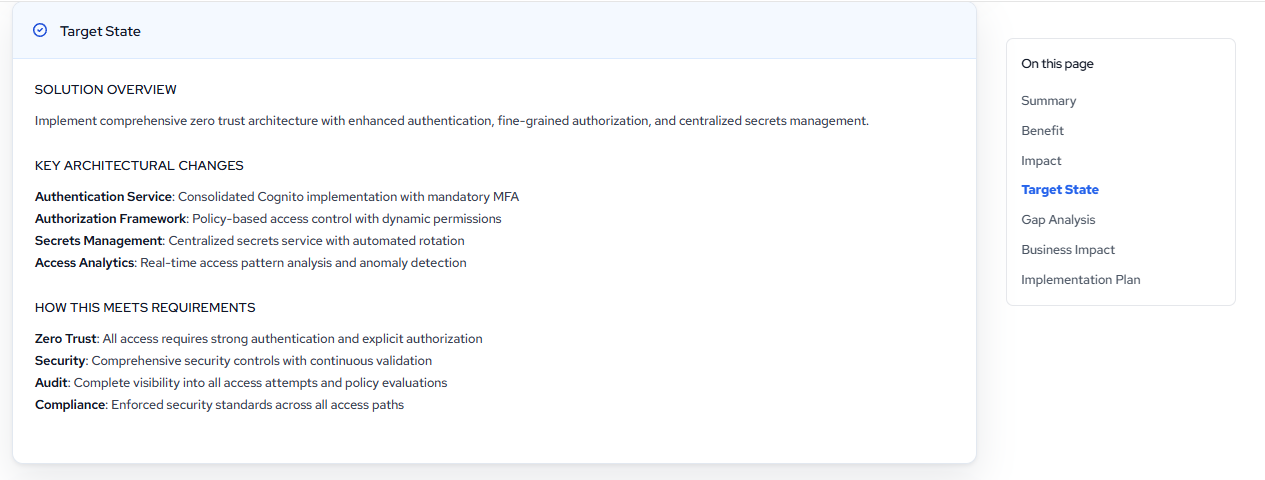
The Target State is your definition of "done." Read the Solution Overview and Key Architectural Changes together as the picture of where the blueprint is taking you. For the order-management migration, that picture might be an API gateway fronting independently deployable services, a message broker handling asynchronous events between them, and a dedicated data store per service.
Evaluate it by asking:
- Is "done" unambiguous? Two engineers reading the target state should be able to build the same thing. If it leaves room for interpretation, it is not specific enough yet.
- Does every change earn its place? Each item in Key Architectural Changes should map to a gap below. A change with no corresponding gap is a signal to question why it is there.
- Is it feasible for your team? Compare the target against your current operational constraints, team capacity, and deployment cadence before committing.
If the target state reads as vague, that usually means the workspace context behind it is thin. Add more specific context (SLAs, compliance constraints, service ownership boundaries) and regenerate to sharpen future cycles.
Gap Analysis
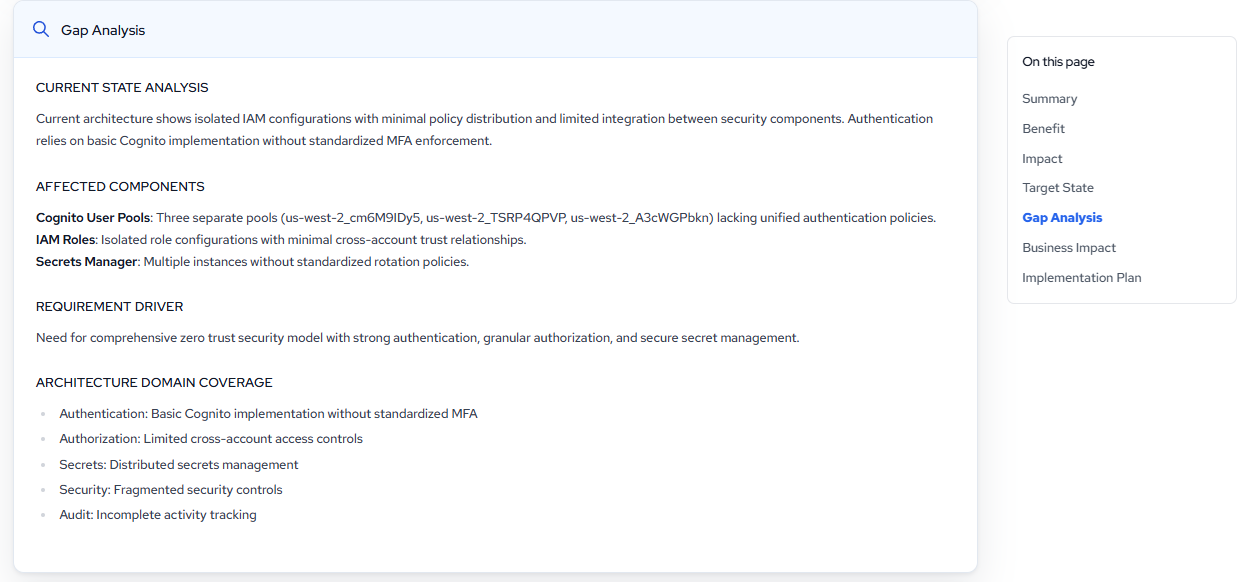
The Gap Analysis is the justification: the delta between where you are today and the Target State. Read the Current State Analysis, Affected Components, and Architecture Domain Coverage as the evidence behind the recommendation.
For the migration, the gaps might surface as a shared database that couples deployments across the monolith, no asynchronous messaging so services depend on synchronous calls, and a single pipeline that blocks teams from releasing independently.
Evaluate it by asking:
- Do the gaps match pain you already feel? Gaps tied to known incidents, audit findings, or cost overruns are strong candidates for immediate action.
- Do you recognize the affected components? They should map to resources your team actually owns and operates. If they do not, the architecture inventory or context may be off.
- Is the risk in each domain real for you? A gap flagged in a domain you have already hardened carries less weight than one in a domain you know is exposed.
If the gaps do not resonate, the context driving them is likely stale or incomplete: review your workspace context to confirm it reflects your current priorities.
Implementation Plan
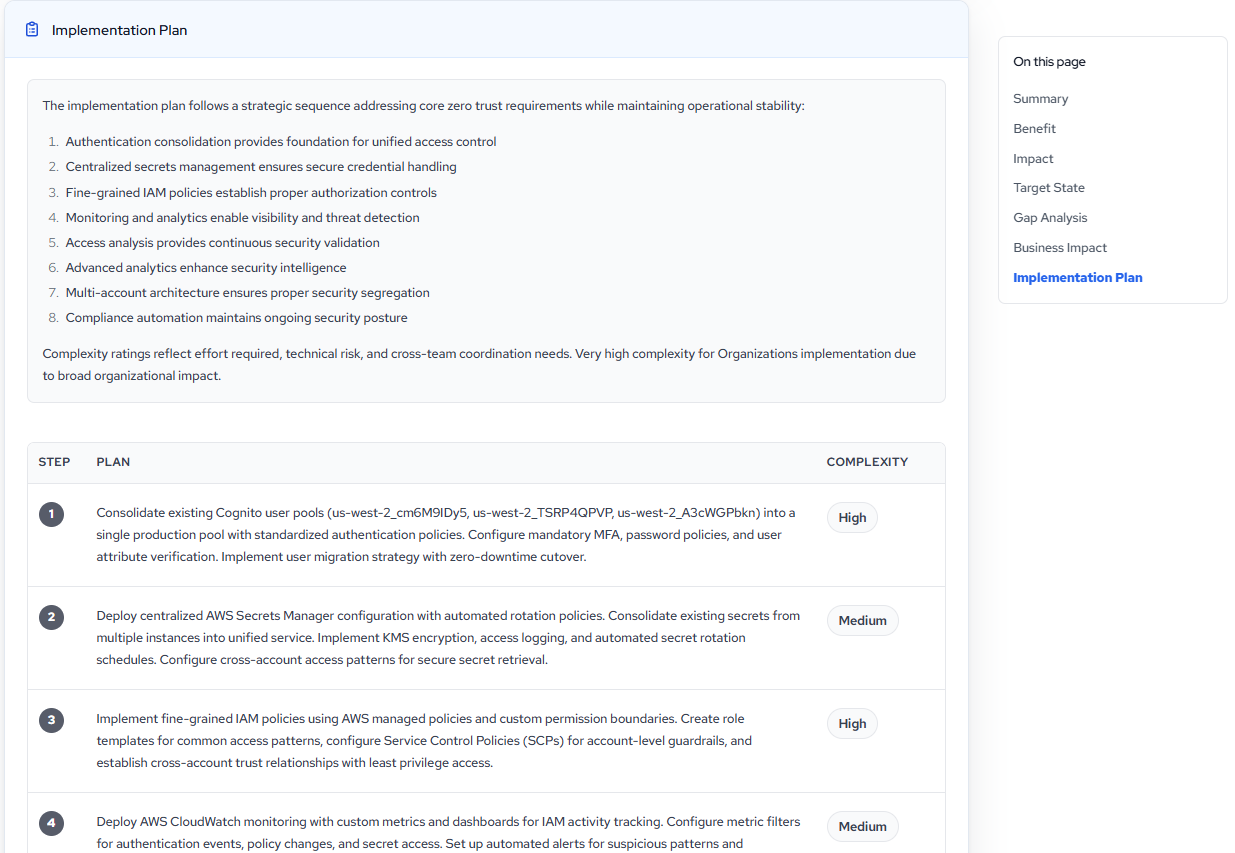
The Implementation Plan sequences the work from your current state to the Target State. Phases are ordered as a dependency chain, and each phase cites the context entry it satisfies through a reference code.
For the migration, an early phase might stand up the networking and the message broker that everything else depends on, a middle phase might extract the first bounded context (payments, say) behind the gateway using a strangler pattern, and later phases peel off the remaining services and retire the monolith path.
Evaluate it by asking:
- Does the sequencing hold? Confirm that early phases really are prerequisites for later ones. Read it as a sequencing guide, not a runbook.
- Does it fit how you actually ship? Validate each phase against your change-management process, sprint capacity, and deployment windows before scheduling.
- Is every phase justified? The reference codes trace each phase back to the requirement behind it. A phase with no clear justification is worth questioning.
- Are there hidden prerequisites? If a phase depends on infrastructure your team does not yet manage, treat it as a separate prerequisite rather than part of this effort.
Once you have evaluated a blueprint and decided to act on it, organize it into a plan: see Building Plans. For the full list of architecture domains referenced in the Gap Analysis, see Architecture Domains.
Updated about 1 month ago